ADSS Guide
How to Select ADSS Cable for Rural Routes in Latin America
A route-first guide to ADSS span, wind, temperature, UV exposure, poles, fittings, drum lengths and quotation data for rural Latin American networks.
Map the route before choosing a span label
A request for 24-core ADSS and a nominal span is not a complete design. Record typical and maximum pole spacing, road or river crossings, changes in direction, terrain, pole condition and access for installation. Rural routes can combine short village sections with one exposed valley crossing. The exceptional span may need separate treatment rather than increasing the weight and cost of every kilometre.
Use local weather data and the project load case
Wind, temperature range, elevation and ice where relevant affect cable tension and sag. Coastal salt, high solar exposure and vegetation add environmental and maintenance risks. Do not apply one climate assumption to Mexico, the Andes, the Caribbean and southern South America. The network designer should provide the load case or approve the assumptions used by the cable and hardware supplier.
Check the electrical environment and sheath
A telecom route on dedicated poles differs from ADSS installed in the electrical field of a power line. For shared utility poles, provide line voltage, attachment position and the utility specification. PE is common for many telecom routes, while anti-tracking performance may be required in defined electrical environments. The words 'power pole' alone are not enough to select the sheath.
Match cable diameter and fittings
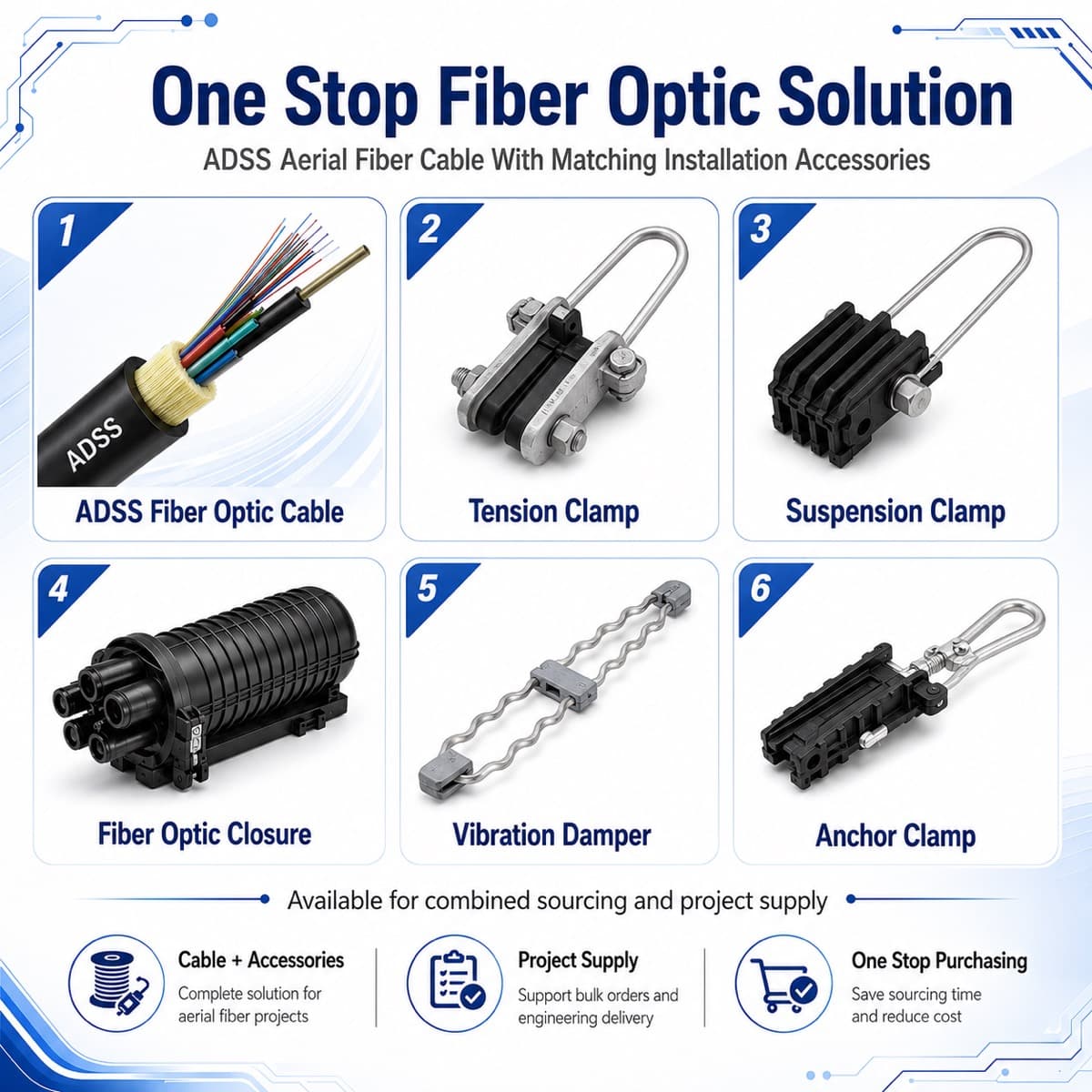
Suspension and dead-end assemblies must suit the finished cable diameter, mechanical design and route angle. Confirm pole material, tangent points, terminations, corner poles, down-lead clamps, storage brackets and vibration protection when required. Selecting fittings from a generic span label can create local pressure, slip or installation delays even when the cable itself is suitable.
Plan drums around installation sections
Drum length should follow access, pulling and tensioning sequence, splice locations, transport limits and the lifting equipment available in rural areas. Longer drums reduce joints but can be harder to move over unpaved roads or unload without machinery. Prepare a drum schedule tied to route sections before production so the cable is not cut into commercially convenient but operationally awkward lengths.
RFQ data for a usable ADSS proposal
Send country and region, route map, typical and maximum span, total length, crossings, wind and temperature basis, pole photos, electrical environment, fibre type and count, sheath requirement, fittings, drum schedule, marking, destination and applicable operator standard. Mark unknown values clearly. A responsible supplier should list assumptions and request missing design inputs before confirming the construction.
Request a Quote
Send product model, fiber count, quantity, route and packing requirements. We will confirm specifications before production.
Request a Quote