Latin America · Subscriber installation
FTTH Drop: Preconnectorized or Field-Spliced?
Choose a subscriber-drop method from the actual route, access and crew conditions. A factory connector changes installation tasks; it does not remove route checks or acceptance testing.
Direct answer: choose by route constraints, then compare total work
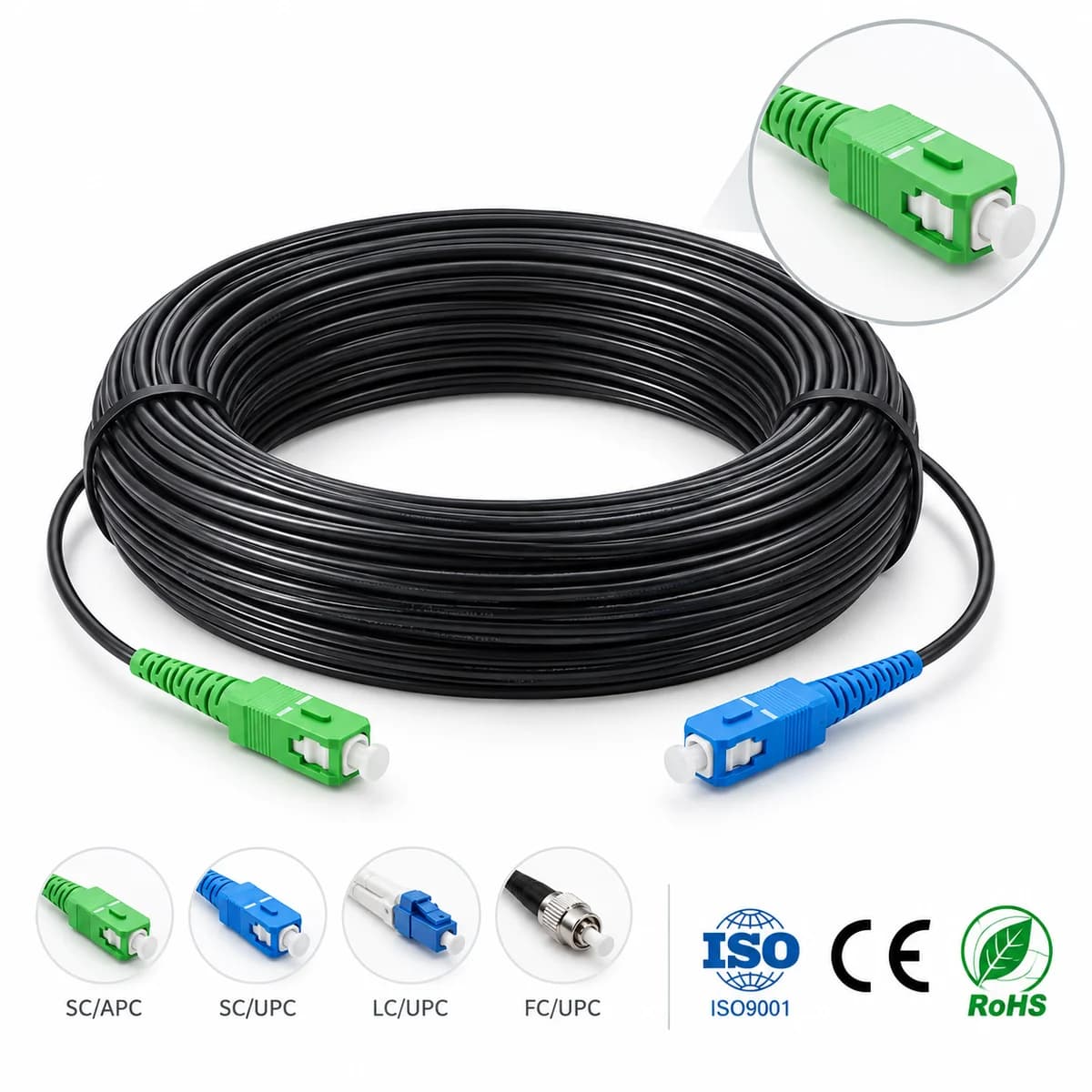
For a Latin American ISP, preconnectorized drop is a candidate when the correct interface and finished length can be confirmed and the protected connector can follow the installation path. Field fusion splicing is a candidate when length must be fitted on site and the team has suitable equipment, access and splice protection. Neither method is universally cheaper or faster. Compare both against the same accepted subscriber connection, including testing and a possible return visit.
Check what must pass through the route
Inspect conduit restrictions, bends, building entries and terminal access before selecting a finished assembly. The protected connector or pulling arrangement can need more space than the cable itself. Corning's preconnectorized installation guidance makes this distinction explicit. Use the dimensions and installation instructions for the actual offered assembly, not the values of another manufacturer's product. Never plan to pull through a connector body or treat its dust cap as a pulling grip.
Measure the path and the place for excess length
A known route supports choosing finished lengths; an uncertain route increases the risk of a short assembly or excessive stored cable. Include the approved path to the termination points and permitted reserve without counting it twice. Confirm where the remaining coil can be accommodated within the cable limits. Fusion splicing can allow length adjustment in the field, but it still needs working length, suitable protection and an approved location for the splice.
Check both ends and the environmental boundary
Identify the terminal port and the customer-side interface separately. A factory SC connector is not necessarily a hardened outdoor connector, and APC and UPC faces are not interchangeable mating interfaces. Confirm the complete connection and sealing arrangement. If the route enters a building, apply the relevant cable and building requirements rather than assuming an outdoor assembly is approved everywhere inside. This guide does not establish a national fire classification or equipment approval.
Compare the crew's complete task
For a preconnectorized option, record handling, routing, inspection and cleaning, connection, reserve storage and acceptance testing. For fusion splicing, also include preparation, equipment setup, a suitable work area, splice protection and records. Factory termination moves a task off site, but does not eliminate connector cleanliness or installed-link verification. Field fusion splicing should not be confused with a mechanical quick connector; that is a separate method requiring its own qualification.
Build a cost comparison without invented savings
Use actual quotations and pilot observations for assembly or cable materials, termination materials, crew time, equipment allocation, travel, testing and rework. Include unused length and variant stock that may remain after rollout. Compare cost per accepted connection, not just price per metre. A lower-priced cable can need additional on-site work; a finished assembly can create a return visit if its interface or length was wrong.
Test representative routes before standardizing
Select a small pilot that includes the route types driving uncertainty, such as a restricted entry, a longer connection and an indoor transition. Record why installation succeeds or stops, the time spent on each task and the acceptance result. Keep the optical method and limits consistent with the operator's approved plan. A successful easy route does not establish that the method works through every existing conduit in the service area.
Turn the result into a material decision
Choose one method, or clearly defined route-specific methods, after the pilot and operator review. Ask FTTH LATAM to quote the approved cable or assembly and matching accessories by variant and quantity. Our product images illustrate options, not proof of an installed local project or certification of every combination. Avoid a universal savings percentage; retain the pilot assumptions so another crew knows when the selection must be reconsidered.
FAQ: Does preconnectorized mean no testing on site?
No. The completed connection still needs the operator's inspection and acceptance procedure. A factory record cannot establish its condition after routing and handling.
FAQ: Is fusion splicing always better for unknown lengths?
It can offer field adjustment, but only with suitable access, trained personnel, equipment and splice protection. Survey the route first rather than using splicing to compensate for missing design information.
FAQ: Can an ISP use both methods?
Yes, if each route class has an approved material configuration, work method and acceptance record. Keep the variants identifiable so crews do not substitute them informally.
Installation-method decision matrix
| Route condition | Preconnectorized review | Field-fusion review |
|---|---|---|
| Restricted path | Protected connector and pulling arrangement must pass | Cable path plus accessible splice location |
| Length uncertainty | Survey, finished-length variants and reserve space | Field adjustment plus working length |
| Crew resources | Handling, inspection, cleaning and test tools | Splicer, preparation, protection and test tools |
| Acceptance | Installed link evidence, not only factory report | Splice and installed link evidence |
| Cost | Assembly, stock variants, travel and rework | Cable, termination, field time and rework |
Pilot before selecting the rollout method
- Identify terminal interfaces and indoor/outdoor boundaries.
- Check route restrictions using the offered assembly dimensions.
- Measure length ranges and confirm reserve storage.
- Record available crew tools, skills and access windows.
- Compare both methods using the same acceptance plan and actual costs.
- Release route-specific material lists and record conditions requiring a new review.
Related product and route information
Installation background — confirm the supplied assembly
Compare methods against a real installation route
Send the country, route sketch, terminal interface, duct and entry restrictions, surveyed length range, indoor/outdoor requirements and crew capabilities. We can quote the approved material scope without assuming a labour saving.
Send the Pilot Route Conditions