FTTH Guide
Outdoor vs Indoor Drop Cable: Which One Belongs on an FTTH Route?
A route-based comparison of outdoor aerial and indoor FTTH drop cable covering exposure, support, jacket, building entry, fibre handling and accessories.
Draw the route across the building boundary
Mark the distribution point, aerial or wall section, building entry, riser or corridor and customer outlet. Outdoor and indoor drop cable solve different exposure and installation problems. One cable may be permitted across the whole route only when its verified performance and local building rules cover every section.
Outdoor drop cable handles weather and support
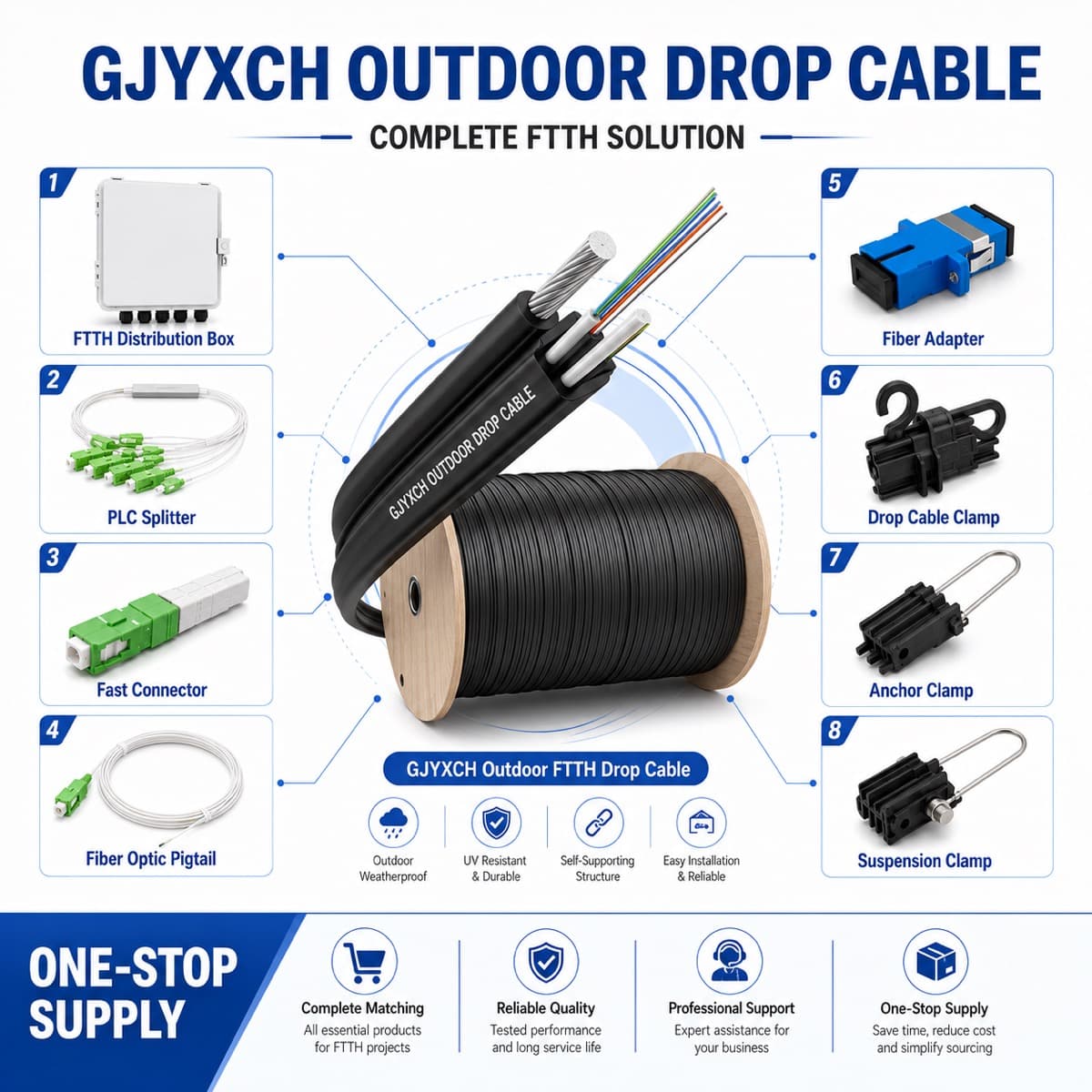
Outdoor cable must address sunlight, moisture, temperature and the mechanical support method. Self-supporting flat constructions use a separate messenger for an aerial span; strength members beside the fibre protect the cable body. Confirm span, wind, attachment and compatible clamps rather than buying by model code alone.
Indoor drop cable follows premises requirements
Inside a building, flame, smoke, routing and bend handling can govern the jacket choice. State whether the cable runs in conduit, tray, riser, corridor or directly on a wall and which local code or operator rule applies. An outdoor PE jacket is not automatically acceptable throughout occupied premises.
Plan a controlled transition
Where outdoor cable stops at the entry, provide a protected splice, connectorized transition or approved indoor-outdoor cable. Keep bend radius, sealing, grounding of metallic elements and technician access in the design. The cheapest material transition can create the most expensive fault point if it is exposed or inaccessible.
Match fibre, messenger and strength members
Confirm fibre type, count and bend performance; messenger material and size; steel or FRP strength members; finished dimensions; stripping method and termination. Steel and FRP solve different electrical and handling needs. Ask for a sample when installers must use a specific connector or stripping tool.
Include the small installation materials
List anchor or suspension clamps, wall clips, protective conduit, entry seals, terminal boxes, adapters, pigtails and connectors by route section. Clamp range must match the finished cable. A complete subscriber connection is a cable-plus-hardware system, not one reel and a generic accessory carton.
RFQ checklist
Send indoor and outdoor length per subscriber, maximum aerial span, building-entry detail, fibre type and count, jacket and fire requirement, messenger and strength-member preference, coil length, colour, printing, termination, clamps, boxes, quantity, destination and project standard.
Plan the outdoor-to-indoor transition
LATAM projects often combine exposed façades, aerial subscriber drops and short indoor runs. Mark the building entry, UV-exposed length, fire requirement, connector or splice point and clamp position on the route sketch. This avoids treating one drop-cable construction as suitable for every section.
Request a Quote
Send product model, fiber count, quantity, route and packing requirements. We will confirm specifications before production.
Request a Quote