
Latin America · PON procurement
FTTH Splitters: Check 1:8, 1:16 and 1:32 Before Ordering
For Latin American ISPs, choose a split ratio against the approved optical path and subscriber plan. Turn the loss calculation into an identifiable splitter order, not just a port count.
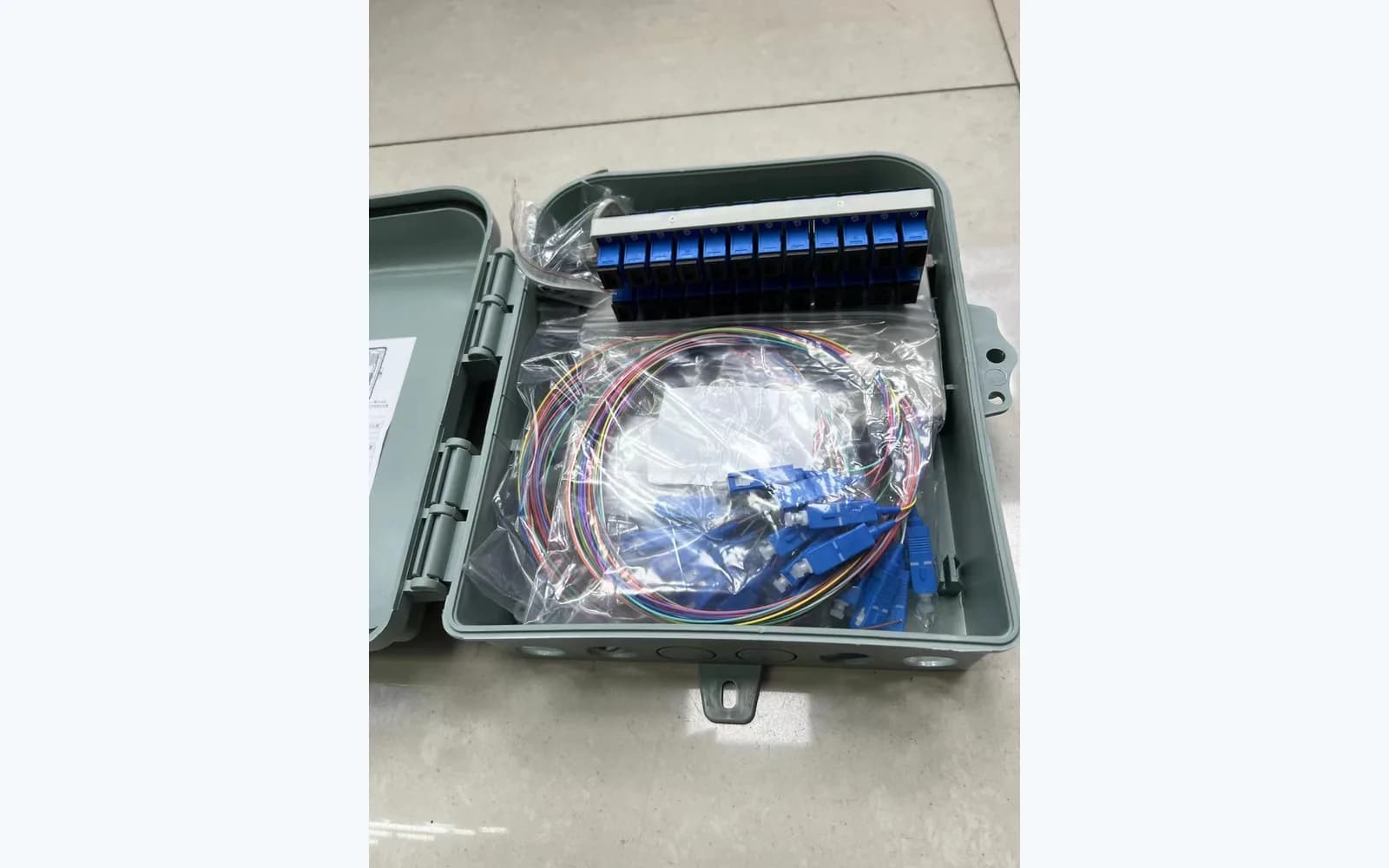
Choose the ratio from an approved optical path
For a Latin American ISP, 1:8, 1:16 or 1:32 is a network-design choice before it becomes a purchasing choice. Confirm that the complete path meets the equipment's optical requirements with the operator's engineering margin, and that the subscriber plan fits the network capacity. More outputs do not create more optical power. Procurement should receive the approved ratio and component limits rather than select a splitter from a housing photograph.
Use ideal division loss only to understand the comparison
For an equal 1:N split, ideal division loss is 10 log10(N): approximately 9.03 dB for 1:8, 12.04 dB for 1:16 and 15.05 dB for 1:32. These are theoretical values, not acceptance limits for a product. For purchasing and design, use the offered splitter's specified maximum insertion loss at the relevant wavelengths and conditions. Confirm whether that figure includes its connectorized interfaces so they are neither omitted nor counted twice.
Record every stage on the actual subscriber path
A 1:4 stage followed by a 1:8 stage gives an overall 1:32 division on that branch. Add the specified losses of both stages and the intervening connections when reviewing that path. Do not add the losses of unrelated parallel branches, and do not replace the two product specifications with the ideal 1:32 value. Splitter location also affects fibre allocation, enclosure space and later maintenance, so keep the topology drawing with the budget.
Check both the high-loss and short-path conditions
The design owner should reconcile fibre attenuation, splitters, splices, connections and any additional passive devices for the relevant wavelengths and directions. Reserve the project's required margin for the agreed contingencies. Check receiver sensitivity at the high-loss end and overload or minimum-loss constraints at the short-path end, using the actual equipment specifications. A generic GPON budget is not an approval for every OLT, ONT or upgraded network.
Make the arithmetic inspectable
Illustrative example, not product ratings: assume an approved maximum path loss of 28 dB and a separate 3 dB margin. A proposed splitter allowance of 17 dB plus 3.5 dB for fibre, 1.0 dB for connections and 0.5 dB for splices totals 22 dB. Adding the margin gives 25 dB, leaving 3 dB against the assumed maximum. The design still needs its other checks. If an alternative splitter adds 3 dB, that headroom disappears. Use real approved values before ordering; do not treat this example as a recommendation for a particular reach or ratio.
Do not confuse optical feasibility with service capacity
A path that passes the optical calculation is not automatically the best commercial design. The ISP must also approve the equipment-supported ONU count, service profile, expected utilization and expansion plan. Separate premises passed, initial connections and reserved outputs in the purchasing schedule. A lower split ratio may need additional upstream resources; a higher one needs its own optical and service review. Compare the complete area plan rather than just the price per output.
Translate the approved choice into a complete SKU
State input and output count, number of stages, required insertion-loss limit and measurement conditions, package format, fibre leads, lengths, connector family and polish at every interface. Confirm module dimensions and routing against the intended box. Keep SC/APC and SC/UPC as distinct interfaces and do not plan a direct mating between them. Ask for the agreed identification and optical inspection records. FTTH LATAM can quote passive materials to this controlled scope in Spanish or English.
Release quantities by area and design revision
Assign the approved variant to each cabinet, building or service zone, with quantities for the initial phase and later expansion identified separately. If a splitter reference changes, send its actual specification back to the designer before accepting the substitution. Reuse the earlier box-capacity guide for existing infrastructure, but treat this new article as a pre-order ratio and budget review. The cover is a terminal-box product sample, not evidence of a particular split ratio or a local installation.
FAQ: Is 1:32 always better value than 1:16?
No. Compare the approved optical and service design, upstream resources and complete installed scope. The price of a passive component is only one line in that comparison.
FAQ: Can we design using the ideal 15.05 dB for 1:32?
Not as the product allowance. Use the supplied maximum insertion-loss specification with its wavelength and interface boundaries, then include the remaining path losses and approved margin.
FAQ: Does a cascaded 1:4 and 1:8 need the same loss allowance as one 1:32?
Not necessarily. Although the overall division is 1:32, the actual component losses, connections and route arrangement can differ. Calculate the path from the exact products.
FAQ: Can the supplier choose a ratio from the number of homes alone?
That can support an initial discussion, not final design approval. Provide topology, equipment requirements, route information and the operator-approved budget before fixing the order.
Ratio and purchasing checks for an equal-split PON
| Choice or field | Comparison reference | What procurement must confirm |
|---|---|---|
| 1:8 | Ideal division loss: 9.03 dB | Offered maximum loss and the approved upstream allocation |
| 1:16 | Ideal division loss: 12.04 dB | Actual path loss, service plan and reserved outputs |
| 1:32 | Ideal division loss: 15.05 dB | Actual path loss, equipment limits and engineering margin |
| Cascaded stages | Ratios multiply; path losses in dB add | Every stage and connection on the selected branch |
| Order release | Theoretical numbers are not product specifications | Exact model, interface boundaries and accepted design revision |
Six checks before placing the splitter order
- Identify the operator's equipment and optical requirements.
- Draw the full path and list every splitter stage.
- Use actual maximum component losses and avoid double-counted interfaces.
- Confirm the engineering margin, short-path limits and service plan.
- Freeze the package, connectors, lead lengths and enclosure fit.
- Release quantities by zone with the approved specification and revision.
Passive products and project planning
Optical-budget and topology background
Send the topology and loss schedule together
Provide the country, OLT and ONT optical requirements, splitter stages, route lengths, approved loss schedule and margin, connector interfaces, enclosure references and quantities by area. We can quote the specified passive components and flag missing product information.
Send the Splitter Procurement Schedule